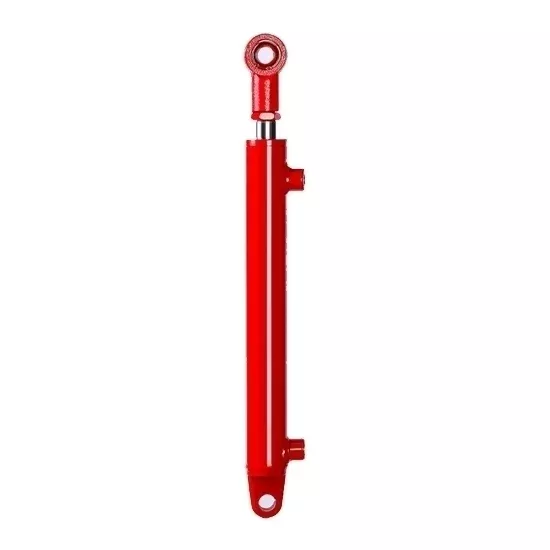
Heavy duty double acting welded hydraulic cylinder consists of a cylindrical barrel, piston and end cover, all firmly welded together. These welded clevis hydraulic cylinders are available in various bore sizes and strokes and can be used in a wide range of industrial and mobile equipment, including mini excavators, robots, log splitters, dump trucks, presses, dump trailers, etc.
Specification
| Model | ATO-HSG401000 | ATO-HSG501000 | ATO-HSG631000 | ATO-HSG801000 | ATO-HSG1001000 |
| Acting Type | Double Acting | ||||
| Stroke | 40 inch (1000mm) | ||||
| Rated Pressure | 16Mpa | ||||
| Installation | Double Ear Welding Type | ||||
| Speed Ratio | 1:3 | ||||
| Bore Diameter | φ40mm | φ50mm | φ63mm | φ80mm | φ100mm |
| Load Capacity | 2 Ton | 3 Ton | 5 Ton | 8 Ton | 12 Ton |
| Rated Push Force | 30772N (3 Ton) | 30772N (3 Ton) | 49850N (5 Ton) | 80384N (8 Ton) | 80384N (8 Ton) |
| Rated Pull Force | 21121N (2 Ton) | 21121N (2 Ton) | 31681N (3 Ton) | 48984N (5 Ton) | 49014N (5 Ton) |
| Oil Port | 18*1.5 | 18*1.5 | 18*1.5 | 18*1.5 | 22*1.5 |
Note: If you need to customize welded hydraulic cylinders of other sizes, including bore diameter, stroke, etc., please feel free to contact us.
Dimension (Unit: mm)
ATO-HSG401000
ATO-HSG501000
ATO-HSG631000
ATO-HSG801000
ATO-HSG1001000
| Model | Inner Diameter | Outer Diameter | Rod Diameter | Stroke | Oil Port | Pin Hole | Installation Distance | Total Length |
| ATO-HSG401000 | 40 | 50 | 25 | 1000 | 18*1.5 | 20 | 1230 | 1280 |
| ATO-HSG501000 | 50 | 60 | 28 | 1000 | 18*1.5 | 20 | 1240 | 1290 |
| ATO-HSG631000 | 63 | 73 | 35 | 1000 | 18*1.5 | 30 | 1270 | 1340 |
| ATO-HSG801000 | 80 | 90 | 50 | 1000 | 18*1.5 | 40 | 1300 | 1380 |
| ATO-HSG1001000 | 100 | 112 | 63 | 1000 | 22*1.5 | 50 | 1370 | 1460 |
Tips: Do you need to bleed air from hydraulic cylinder?
Hydraulic cylinders typically do not require bleeding like pneumatic systems because they operate with incompressible fluids, such as hydraulic oil, instead of gases. Bleeding is necessary in pneumatic systems to remove trapped air, which can affect performance. In hydraulic systems, air can still be problematic, but the procedure is different.
Air in a hydraulic system can cause issues like reduced efficiency, spongy response, or noise, but it’s usually purged during the initial system filling or maintenance. When installing a new hydraulic cylinder or servicing the system, it’s essential to follow proper procedures to ensure all air is evacuated. This may involve cycling the cylinder to force air bubbles out, using bleed valves, or using a vacuum pump. Regular maintenance and monitoring are crucial to prevent air ingress over time. So, while hydraulic systems don’t require regular bleeding, managing air during initial setup and maintenance is vital to ensure their proper operation.