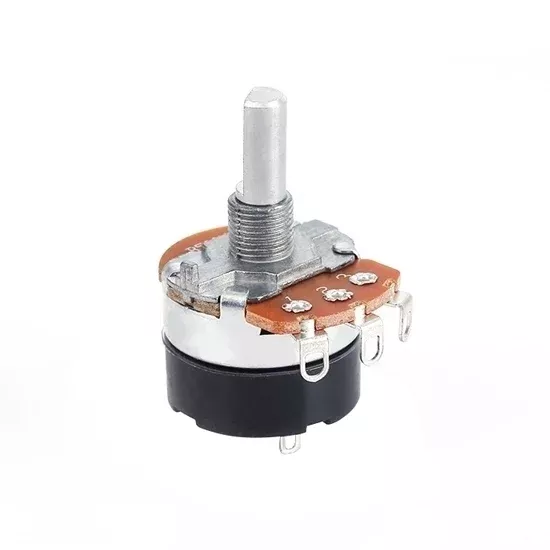
linear taper rotary potentiometer with a resistance value of 100K Ohm, a convenient kit for fixing knobs on amplifiers or other appliances. The rotary potentiometer with on-off switch is compact and can be easily integrated into your design.
Specification
- Model: ATO-RP-100K
- Resistance Value: 100K ohm
- Switching Power: 1A
- Temperature Range: -10°C~100°C
- Service Life: ≥ 10,000 cycles, ≥ 20,000 cycles
- Application: Multimedia, speakers, amplifiers, light regulation, etc.
Features
- A rotary potentiometer provides variable resistance along its rotational axis.
- Rotary potentiometers are available in different configurations and sizes, offering a wide range of resistance values and power ratings.
- 100K Ohm rotary potentiometer can be found in various applications, including audio equipment, robotics, industrial control systems, and consumer electronics.
- The potentiometer is designed to be rotated manually, allowing for precise control over the resistance. The resistance value changes proportionally to the angle of rotation.
Dimension(unit: mm)
Applications
Rotary potentiometers are commonly used in a wide range of applications, including audio systems (such as volume control), instrumentation, robotics, and electronic circuits where manual control or adjustment is required. They provide a simple and cost-effective means of adjusting voltage, current, or signal levels in a circuit.
Tips: What is a rotary potentiometer?
A rotary potentiometer, often referred to as a rotary pot or simply a potentiometer, is an electrical component used to measure and control the position or rotation of a mechanical shaft. It is a type of variable resistor that provides a variable voltage output based on the rotational position of its shaft.
The basic construction of a rotary potentiometer consists of a resistive element, typically a thin, coiled wire, that is wound around a circular core. The resistive element is connected to three terminals: the input terminal (often referred to as the “wiper” or “slider”) and two outer terminals (often referred to as the “end terminals”).